Visit
BRÓDNO JEWISH CEMETERY
The Bródno Jewish Cemetery, located at 15 św. Wincentego Street, is the oldest surviving Jewish cemetery in Warsaw and the largest Jewish cemetery in Poland in terms of the number of burials. The earliest known burial took place here in 1743, and by the time the cemetery was closed following the sealing of the Warsaw Ghetto on 16 November 1940, approximately 250,000 people had been laid to rest there. Today, the cemetery covers an area of 14.6 hectares and remains one of the most important witnesses to the history of Warsaw's Jewish community.
The cemetery contains the graves of people from every social class—from merchants and craftsmen to scholars, entrepreneurs, and community leaders. It is also the final resting place of soldiers of Berek Joselewicz's Regiment of Light Cavalry, who fell defending Warsaw's Praga district during the Kościuszko Uprising, as well as civilian victims of the Praga Massacre of 1794.
Among the best-known individuals buried at Bródno are Szmul Zbytkower, a merchant, banker, and supplier to the court of King Stanisław August Poniatowski, and Abraham Stern, an outstanding inventor, scientist, rector of the Warsaw Rabbinical School, and the only Jewish member of the Warsaw Society of Friends of Learning. Archaeological research carried out in recent years made it possible to identify the approximate location of Stern's grave and erect a new headstone in his memory.
The cemetery courtyard features Warsaw's oldest surviving matzevot (Jewish headstones), dating from 1795 and 1798, as well as a unique tombstone with faithfully reconstructed historic polychrome decoration. Conservation research has shown that before the Second World War most Jewish gravestones were painted. Analysis of the surviving pigments has made it possible to recreate their original colours, offering visitors a glimpse of the cemetery's former appearance.
The post-war fate of the cemetery is among the most tragic chapters in its history. Between 1948 and 1951, on the orders of the communist authorities, thousands of surviving gravestones were torn from their original locations. Some were used as building material, while approximately 40,000 matzevot were gathered for removal. Ultimately, they remained on site, creating the world's largest concentration of displaced Jewish gravestones—a powerful landscape of remembrance and one of the most moving symbols of the destruction of Jewish heritage in Poland. After the war, the cemetery grounds were designated as a public park, and the sandy dunes were planted with forest.
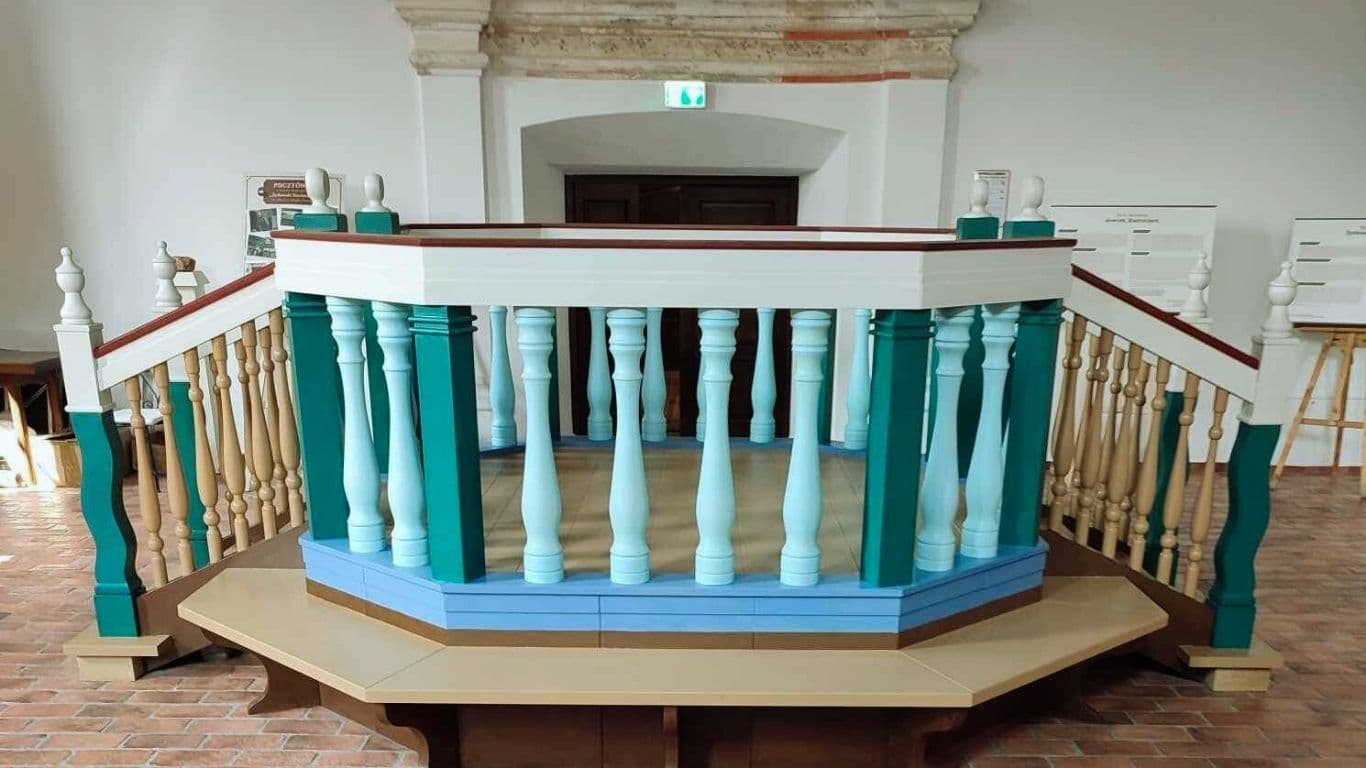
In the late 1980s, thanks to the efforts of the Nissenbaum Family Foundation, a monumental entrance gate decorated with reliefs illustrating the cemetery's history was erected, and the main avenue leading to a symbolic empty pedestal was paved. In December 2012, the cemetery, which had previously been owned by the State Treasury, was returned to the Jewish Religious Community in Warsaw. The perimeter wall was rebuilt and visitor facilities were constructed. In February 2018, the permanent exhibition Beit Almin – House of Eternity, dedicated to the history of the cemetery and Jewish traditions and customs relating to death, burial, and remembrance, was opened.
To this day, more than one hectare of the cemetery's historic grounds remains outside the existing fence and beyond the ownership of the Jewish Religious Community in Warsaw. This area contains the burial sites of several thousand people and is still not adequately protected.
Although the Bródno Jewish Cemetery is no longer an active burial ground and no contemporary burials take place there, it remains one of Poland's most valuable monuments of Jewish heritage and an exceptional testimony to more than two centuries of the history of Warsaw's Jewish community. It is a place of remembrance, reflection, and education, preserving the memory of Jewish life in historic Warsaw and reminding visitors of the responsibility to safeguard this heritage for future generations.
Admission: 20PLN
For more information, follow the Cemetery’s Facebook Fan Page